


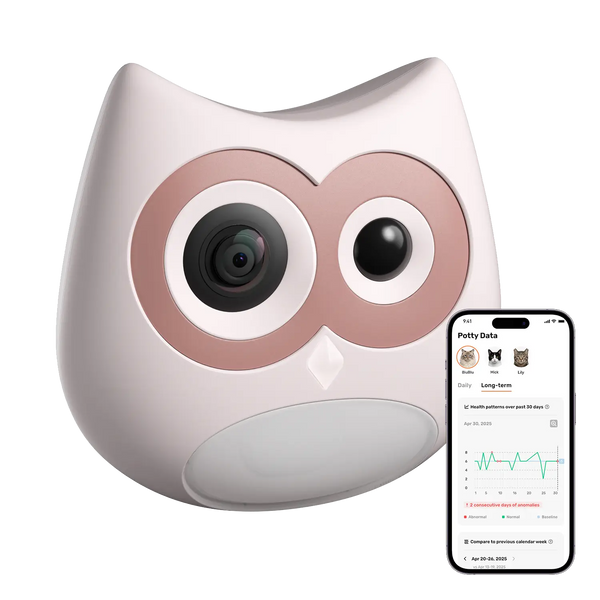
How does LitterLens AI work? LitterLens is a small camera that sticks or clips onto a litter box, wakes up when a cat steps in, records the visit, and uses AI to log each cat's visit count, time in the box, stool shape and colour, and urine clump events. It compares every cat with its own normal pattern and flags changes, so you can check the litter box and call your vet sooner. It is an early-warning tool. It does not diagnose anything.
How does LitterLens know when a cat is in the box?
The LitterLens camera sleeps while the litter box is empty. In that state it keeps only its network connection and an infrared sensor running. When a cat walks in, the sensor picks up the change in heat and wakes the camera. A pet detection algorithm then double-checks that the visitor really is a pet before recording starts. When the cat leaves the frame, the camera goes back to sleep.
This wake-on-visit design is why a full charge lasts about one month under typical use, meaning a cat that uses the box around 8 times a day. Battery life is shorter with more cats, more visits, long live-view sessions, frequent night recording or a weak Wi-Fi signal. You can also run the camera plugged in, and then it works continuously with no battery limit.
In dim rooms, a white night light comes on slowly so it does not startle the cat. Video is 1080p at 15 frames per second, and you can watch live from the app at any time.
What does LitterLens record on every visit?
Each time a cat uses the box, the camera saves a video clip of the visit. If it sees stool, it also saves a photo of it. The app adds the visit to a timeline and updates two daily numbers for that cat: total visits and average time in the box.
The app also lets you switch between cats, review clips, and compare today with earlier days. Family members you invite (up to 5) can view the videos, photos and data, but they cannot change your device or pet settings.
The lens covers a 134° by 84° field of view. That is wide enough for most of a litter box, provided the camera is placed so the litter area is clearly visible in the live view. There is a How It Works page on the store if you want the short version.
How does the AI read stool?
When the camera captures stool, an image model locates it in the frame and classifies it. LitterLens sorts stool into two groups of changes:
- Shape: hard pellets, soft or pudding-like, and watery.
- Colour: black or tarry, bright red, grey, green, and orange-yellow.
Anything that looks unusual appears on the event timeline with a photo and a time, so you can look at it yourself. Lighting, food and camera angle can change how stool looks on video, so treat the flag as a prompt to check the litter box, not as a result. If you want a reference for what different stool looks like, our cat fecal score chart explains how vets score it.
How does LitterLens tell multiple cats apart?
In a multi-cat home, a stool photo is only useful if you know which cat it came from. LitterLens handles this with a feature called Pet ID+. New visits start as unassigned. You tag one visit for each cat in the app, choosing which cat is in the video, and after that the app assigns future visits automatically.
The recognition rate is about 80% or better overall, and it depends on how many cats you have, how similar they look, and the lighting. Accuracy drops as the household grows: the app warns that accuracy will drop once you have added 5 cats, and it accepts up to 10 in total.
If the app gets one wrong, you can correct the label in the video, and the corrections help the model improve. A subscription adds a more accurate multi-cat recognition model. For homes with several cats, the multi-cat health monitoring collection lists the camera and multi-camera bundles, and our guide to multi-cat litter box identification goes into the tagging steps.
How does it know what is normal for your cat?
Normal differs from cat to cat, so LitterLens does not use one fixed number for everyone. It starts building a baseline for each cat after about 7 days of valid, normal data, and the baseline becomes stable after roughly 30 consecutive normal days. The frequency and duration colours in the app show how far today is from that cat's own baseline.
Three kinds of change get flagged:
- An unusual stool shape or colour.
- A visit that lasts much longer than that cat's usual visit, or an average daily time in the box that drifts away from its normal.
- A daily visit count or duration that differs from the previous week or month.
If anything unusual happens on two or more days in a row, the app highlights it as a streak. Weekly and monthly comparisons appear as percentage trends and are not labelled as anomalies. Data refreshes every 2 hours, so a visit may take a little while to show up.
What is free and what needs Care+?
Basic monitoring is free. Care+ is the optional subscription that adds abnormal alerts and longer history.
| Feature | Free | Care+ |
|---|---|---|
| Live view and recording | Yes | Yes |
| Visit count and average time per visit | Yes | Yes |
| Video history | Most recent 72 hours, stored on the device | Up to 1 month of event videos in the cloud |
| Low-battery alert | Yes | Yes |
| Abnormal stool and data alerts | No | Yes |
| Abnormal records and data analysis | No | Kept for 12 months |
Care+ costs $5.9, $9.9 or $12.9 per month, depending on how many devices you have. The plan has to cover at least the number of devices on your account.
What does LitterLens not do?
Knowing the limits matters as much as knowing the features. LitterLens does not measure weight. It does not detect kidney disease, urinary tract infections, bladder stones, vomiting, parasites, dehydration or posture, and it does not diagnose any condition. What it records is behaviour around the box: how often, how long, and what stool looks like. A vet has to confirm what a change means.
Some changes you should watch for yourself. Straining with little or nothing coming out, crying in the box or blood in the urine are signs to act on right away. Cornell's Feline Health Center lists these among the common signs of lower urinary tract disease. A cat that cannot pass urine for 24 hours needs a vet, and a male cat that strains and produces nothing is an emergency.
What does setup involve?
You pair the camera over Bluetooth in the SiiPet app and connect it to a 2.4 GHz Wi-Fi network. 5 GHz networks are not supported. Then you mount it:
- For enclosed and semi-enclosed boxes, the included adhesive mount goes on a flat surface.
- For low, open boxes, an optional clip-on bracket attaches to the box wall. You can find it in the mounts and holders collection.
The camera works best on a litter box larger than an L size, roughly 50 x 38 cm (about 20 x 15 in) or bigger. For cats over 5 kg (11 lb), the recommended size is 50 x 45 cm or bigger. It is not recommended for automatic or self-cleaning litter boxes. Our guides to placing the camera and litter box size cover the details.
The body is rated IPX5, so you can rinse it under running water when it gets dirty, but it should not be soaked. A quiet, low-traffic spot helps cats feel comfortable and gives steadier recordings.
What should you do when the app flags something?
Start by looking at the clip and the stool photo, then check the litter box yourself. One odd visit is not unusual.
A change that repeats over two or more days is worth a call to your vet, and you can show them the timeline. If your cat has repeated watery stool, visible blood or severe lethargy, see a vet right away. For no stool in 48 hours, call your vet. Cornell's guide to constipation explains why straining and small, hard stools deserve attention. If your cat starts avoiding the box, the ASPCA's litter box problems guide covers both medical and behavioural causes.
FAQs About How LitterLens AI Works
Can I turn the camera off?
Yes. Privacy mode switches the camera off from the app. While it is on, the camera will not wake up or record litter box visits until you turn it back on.
Does LitterLens work with a self-cleaning litter box?
Not recommended. LitterLens is designed for standard litter boxes with a flat mounting surface.
Does the AI replace a vet visit?
No. The app's insights are informational only. They can help you notice a change early and give your vet a dated record, but only a vet can say what a change means.
Can I use it with more than one cat?
Yes. Tag each cat once and the app sorts later visits automatically. Expect about 80% or better accuracy overall, with more mistakes as the number of cats goes past 5.


